
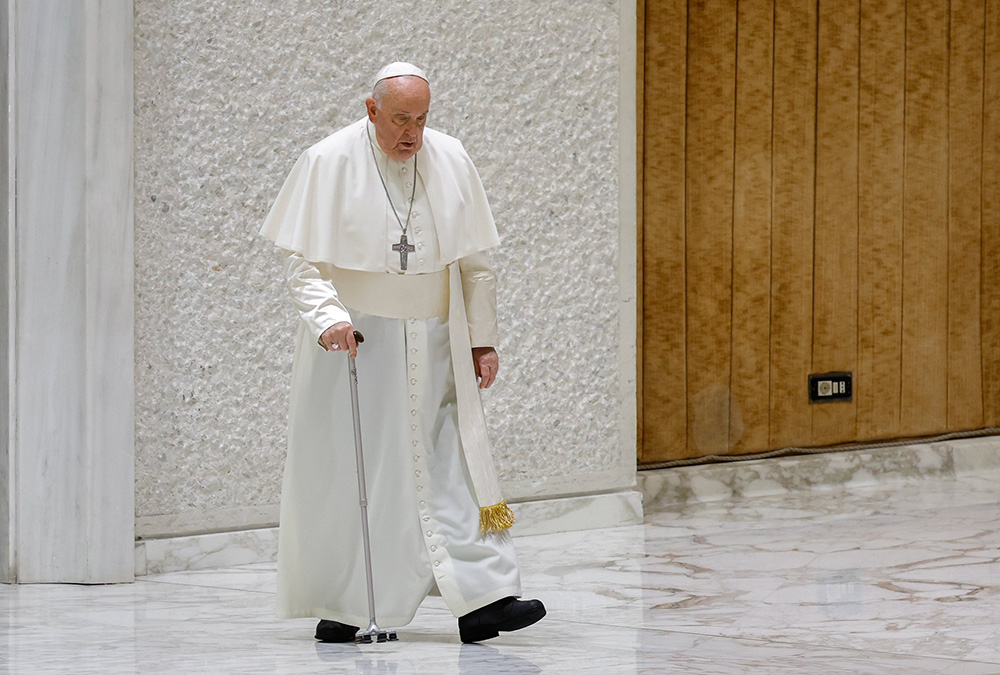
In the wake of the death of Pope Francis I, I want to visit the moment that, for me, was most telling of his Papacy and his alignment to synodality, a word that is often forgotten in the grandness of the office of the Papacy. He wanted to find the common ground on which we could all, most of us, come together to do the work without the faff, to have a dialogue and discernment and a mutual space in which to have differences but find common ground for the common good. When Pope Francis was elected as Pope, his opening shot was on immigration, which remains the issue of the day, but also was one he was very acutely aware of and shared a kinship with having been a child of immigrant parents into Argentina. Very early on in his reign, as the first Pope from the Americas and the Jesuit order, he visited the island of Lampedusa and threw a wreath into the water in honour of the migrants who lost their lives in a crossing on those waters. His first words were on service to the poor and the humanity of those who exist in the fringes where society have relegated them; the hungry, the downtrodden, the excluded… all elements of Christ’s teachings. He was a Pope who talked about humanity, above religion, the church, power, politics… it was a guiding word for him, and as a child of migrants whose parents fled Italy to have a life in Argentina, he had a keen insight into the problems that plagued the humanity of migrants, especially.
Having a Pope who is not only progressive but one who recognises the larger role of the church in society, showcasing the human in the realm of the spiritual, flaws and all, makes a difference. For some reason, I remember thinking at the time of conclave, following the death of Pope John Paul II, that there was no way that they would allow a progressive into the halls of the Vatican, especially after the reign of a Pope who brought much freshness into the Church, who through sheer charm often times, was able to bring people closer to God. The Pope whose opening shot was to the bowels of Communism because that was the issue of the day, and being an Eastern European Cardinal had lived through communism. The tenure of John Paul II came only because John Paul I died some 33 days into his reign and that of Pope Francis came because Pope Benedict XVI had decided he was no longer the person to lead the Church and in an unprecedented move, resigned the position. These are the moments that feel almost like divine intervention, the death of a Pope is sad in every respect, but it feels like the hand of God is making a move having oversight into moments ahead of us. The death of John Paul I opened up a space for a more progressive, pragmatic, charming and effusive Pope; a man who should probably not have been Pope but needed to be. One who did not seek the position but was ordained to it, dare I say, the hand of God at work. Likewise the resignation of Benedict XVI gave way to the election of a man whose vocation was more pastoral than doctrine who disregarded the grandness of the position and led a more simplistic life as much as the office would allow. A man whose message to the youth was to make a little mess for change and warned about the dangers of the dogma that plagued a Church with an unwillingness to evolve. These are moments that reveal the soul of a person when called to be a successor of St Peter, a position he did not seek out, but come the moment, understood the sheer magnitude of it in the context of the wider world.

Pope John Paul II died on the first Sunday after Easter, and Pope Francis died on Easter Monday… there is an irony and a joke in there somewhere that we can all come together and appreciate when it’s not so fresh in our minds. His death during this time, is a deeply moving moment for us as Catholics, because it is the most solemn time in our religion, it informs the world about us being the “Easter People” who dwell on hope through the journey of lent and the gladness at the resurrection of Christ. It is a time we are more aware, than any other, what it means to be Catholic and so for Pope Francis’ last message to us to be, “Buona Pasqua”, it is both beautiful and deeply solemn. If a little sad that we have lost our Papa.
I wasn’t a fan of Pope Emeritus Benedict XVI when he was elected Pope in the wake of Pope John Paul’s II death. Anyone stepping into that position after the death of John Paul II short of being Jesus himself, was never going to quite cut it, never going to be as popular or beloved, but for the church to have elected someone who was as far off as possible from Pope John Paul II, ensured an disconnect and a discontinuity that would have benefitted the Church throughout the world. This is not to say John Paul II was perfect he was not, his ignorance, for lack of a better word, to do anything concrete on child abuse claims that still plague the church today for one is something that will tarnish any progress the church will make for years to come. Every single Pope has yet to properly handle this and concretely atone for it. It is terrible legacy of the Church that makes any progress imperfect, the vast good done, easily marred. But with the election of Ratzinger, “God’s personal Rottweiler” they nicknamed him, Pope Benedict XVI upon papacy, it signalled a shift away from what progress had been made, and a move back to the ultra-conservative church that refused to evolve and change with the world. A regression back in time to when women were relegated to the background, barely seen let alone heard.
Change is good, if there is one lesson that would benefit the Catholic Church it is that change is ultimately a very good thing, it does not mean a jettison of traditions and foundations of religion, it simply enhances the connection of the church to its people, its foundation and its congregation which is always ever changing. As the saying goes, and often quoted round these parts, if we don’t change, we die.
There was an obvious kerfuffle during Benedict’s brief tenure as Pope, those who were opposed to it were very opposed and those who were in favour were very much in favour with the opinion that the Church had somehow lost its way, in the manner in which Pope John Paul II had taken the church away from the pillars of the religion; allegedly. Ratzinger’s years were not without problems mainly the child abuse problems that plagues the church, but also as a Catholic I could not help but observe that there was a marked lack of interest in the church from its new leaders. Though we observed the tenets of the religion, mass, communion, charity etc. but there was a lack of excitement and outpouring of affection… it felt stifled. But all that changed, when Pope Benedict decided to step down and retire due to health reasons amongst other issues. This was the moment that rocked the Catholic church to its core, in modern times; a stickler for tradition and dogma, was abandoning its fundamental and founding principle. In the history of the Church, this has happened only six times under vastly different circumstances, because being Pope is a position for life, hence one never resigns it easily, because it is a position ordained by God to the entirety of the flock and we take that appointment seriously.
You see, salvation is personal, for those of us who believe, it is a connection to something outside of ourselves that centres us from deep within. It is a source of comfort and grounding. Therefore, saying a prayer is in conversation with God himself, not the priest, not even the Pope. That means something. I myself am a wayward Catholic, I will still clock someone right outside of Church after Mass if they tried me, but we are all deeply flawed innit.
For Pope Benedict XVI to resign from the position ordained to him by God, was a hair short sacrilegious, it had not been done for nearly six hundred years since Gregory XII who was forced to resign in 1415, and his was the first voluntary resignation since Celestine V in 1294 after five months and change in office. So this was big time, and a big deal. It meant that the church would have to vote a new leader in conclave, and this is some of the most rigorous election processes in the world, you think a democratic process is strange, you try being elected Pope. This time the eyes of the world was on the Catholic Church, reeling from the news of the departure of one Pope who had not died, and the election of a new pope. Those who were loyal to the Emeritus would cause some friction with “the people” of the newly elected and where did that leave us? The church was being tested indeed, and this was a score it would have to settle in the glare of the entire world.
I watched, the world watched, as the period of Sede Vacante was being observed, watching that chimney for the black smoke, white smoke, the crowds gathered outside St Peter’s square to observe this period of history and what it would mean for the church. I watched with my mum every day, paying attention to the news and the shift about to come. When Francis was elected Pope, no one saw this coming, not least because it was thought he’d missed his chance with the election of Ratzinger, and he was an outsider, a progressive on the heels of an ultra-conservative, he was a radical even, some said. But he was the right choice for the church, for the most part because he had not done everything right as he could have done. And should have.

We entered the period of two popes, and this is where I laud Benedict for taking the decision to step down, whilst he sighted health issues, I feel, he felt he was not the right one to lead the Church through the years of tumult about to befall it, because it was coming. But also, there is the sense of the spiritual, the ability to speak through God to the people… I don’t know. I watched the movie The Two Popes, on Netflix and it seeks to humanise the Pope and offer up a different perspective on the days leading up to the decision and reasons why. When Anthony Hopkins who plays Pope Benedict’s character says, “he is not there anymore, I cannot hear Him.” Him being God, their communication had become stilted because there was a large part of him that wanted to be Pope, maybe too much, and that clouded his judgement some… I don’t know as I said, but it makes sense in some sense. If that makes sense.
What The Two Popes does is lend a human insight to an otherwise closed world; whilst it may not be factually accurate, it helps in understanding the personal in the grand scheme of the spiritual and more than anything, it tells of the fallibility of humans. The biggest gripe I have often had with the church has been with us the congregation; we seem to forget that the person in front of us is human just like us, our communication is with God but there is a greater reverence placed on the human at the altar than the divine and omnipresent. With the election of Francis as Pope, there was a marked shift in that thinking because it gave way to course correct, to be more progressive to move the church along, as slowly as it wants to, but to move it all the same in the right light. Francis had much work to do chief amongst them, to gently make malleable the iron clad traditions that conservatives still want to hold on to, that stifles us and our progress. Benedict stepping down was a first step in that direction and who would have thought, an ultra conservative Pope taking a progressive step for the benefit of the Church; it was radical in itself and selfless all together. Is this now a new thing for the church? Who knows. Could this be the way the church can operate? Because it didn’t break the world, it didn’t cause a conflict and Benedict being Emeritus did not conflate the roles. And in my opinion, as a member of the congregation, I think this is something the church should think about doing more. I am not a fan of roles for life, I am absolutely not a fan of anyone beyond the age of retirement to be the leader of any organisation because it is detrimental to progress, Personal opinion, but it’s something I take to the bank.

We find ourselves in that unique position for the second time in some of our lifetimes, another death of a Pope, another round of conclave, another season of guessing games and odds, another moment the press will clobber us to death with information on the preferiti. Another time of reflection on our history as Catholics, another set of many eyes on Rome and the dome of St Peter, and that Chimney, another round of conspiracy theorists and not to forget the think pieces. Wild and exciting as the times coming may be, it also call for calm and introspection on the life led by the now late Papa Francesco, what we can learn from it, and how we move forward as a Church, doing better and evolving within a world ever changing.
Pope Francis did not always get it right, but no matter what you think, he was a Pope, a man, a human being willing to try and try he did, many times over, even when he knew how at odds it would put him with the Church and the faithful. His last few acts were FaceTiming the children from the Church of the Holy Family in Gaza on Easter morning which he did every day since the bombardment of Gaza, and visiting the prisoners in the Regina Coeli prison in Rome on Holy Thursday, something he has done since the dawn of his pontificate washing the feet of the prisoners like Chris did, and whilst he could not do it this year, he still yearned to be close to them… that is the measure of humanity.
Requiescat in Pace Papa Francesco.
So what next? There will be nine days of official mourning in the Vatican, its own Nation State, and then a burial in St Peter’s Square followed by a procession to the papal basilica of Santa Maria Maggiore where the Pope will be interred at his request because he had a fondness for the Church and will be buried there as opposed to the grottoes of Peter’s Basilica. And then conclave, where Cardinals only under the age of 80 will attend conclave to chose the next Bishop of Rome, the Pope.