
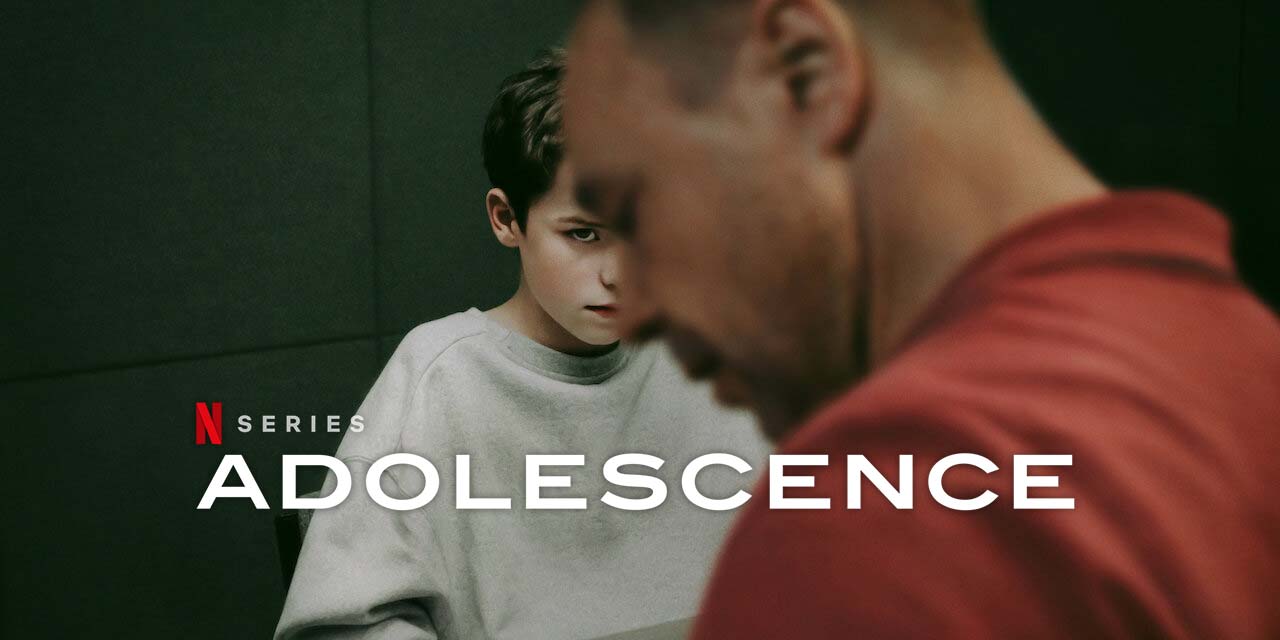
It takes a village to raise a child they say, and Adolescence turns the lens on the village responsible for the child.
In the weeks since the release of this series on Netflix we have had the government lauding the subject matter and even the Prime Minister going so far as to suggest the series should be played in schools because of the rising epidermic we have when it comes to violence against women and girls, and incel culture which has been perpetuated by characters like Andrew Tate and their influence on impressionable young minds.
Adolescence holds the village to account in equal measure with each under the laser focus of the lens and that close under the microscope, nothing looks as pretty.
A crime has been committed; a young girl has been murdered, and a young boy is to blame and so also, is the wider community of which he is a product.
In episode one the police swoop in to arrest the suspect in his home, whilst still in bed. We, the viewer, are none the wiser as to what is happening yet only that a young man has been taken from his home in the early hours, and here we see the suspect as a child, on a Saturday morning who should be dealing with something mundane as going to play football in the park with friends or some such. We see him in the wholeness of his family, aspects of him about to be ripped apart and examined to the minutest of detail. As the episode unfolds, we learn of what he has been accused of, and we see the police follow the process to the letter and interpret the law; they walk that tight rope in piecing together the moving parts of the crime.
In episode two we see the police flailing whilst in the territory of young minds in the schoolyard and social media, how it affects interactions on the playground and in the classroom. This is a core part of the village where these behaviours are not only formed but allied. Until the son of the investigating officer, throws his father a lifeline when he helps uncover and understand what role social media plays in this crime. The victim may not be so innocent, but her actions do not warrant the end of her life. It changes the dynamic of her narrative and shifts things into more focus.
This is the system, and it paints a bleak picture of the institutions into which we send our children, it shows the stretched resources teachers must cobble together to do a fraction of their job but also teachers who really couldn’t give a fuck when it comes to the education system. It also shows how said system does not work with them, yet we expect them to thrive in it. It is harrowing and sad to say the least, but it is also not a far stretch of the imagination in some parts of the country. The resources are at the core of this issue, there aren’t enough of anything to make it last or make an impact therefore, students and teachers exist in this loop of tension that snaps frequently enough for it to be a problem that spools outside of the school environment with dire consequences.
In episode three we come face to face with the system that is meant to get into the mind of the child who has committed what is an adult crime. A system that seeks to understand and make sense of the tragic circumstances of it all. This is harrowing as it is worrying because the child psychologist must constantly pull herself together and remind herself that she is in the company of a killer and not an innocent boy. She is intimidated by him, and he seeks to run circles around her with his constant need for reassurance and unpredictable temperament. She tries, she really does try to get into the mind of the child even if he is anything but despite his age and the crime he has committed, she has to compartmentalise and get him to open up to her, cajole him to reveal more of his psyche especially when it comes to how he sees girls and women in society. There is an imbalance of power here, and most times it is not in favour of the court appointed psychiatrist.
In episode four we return to the home a full circle moment, the family home where the parents and sister must take a hard look at themselves and the community in which they exist. The father’s van has been spray painted with something vulgar, and it so happens to be his birthday. What starts out to be a normal(ish) day for him with his wife fussing over him with breakfast before it turns on its head when he sees the spray paint on his beloved van. The parents go through every layer of their parenting, coming to terms with the fact that they may just have taken their eye off the ball long enough to feel like terrible parents, inadvertently. When life gets in the way of parenting and how they make up for it by distracting a child, giving them their freedoms and maybe being a bit too disconnected in what they are really getting up to behind closed doors in a bid to give them independence. Just where do they draw the line, and how would they have acted differently in hindsight? The last ten minute of this episode may be some of the best and finest acting we have ever seen on British TV; it is a reckoning. It is a scene that must weigh on every parent’s minds as they too try to navigate the new age in which children are growing up.

It is all well and good for the prime minister to say this should be shown in every school, and as good a sentiment as that is, the government still fails to grasp a big part of the issue, the eradication of community, thanks in no small part to the removal of communal spaces for children outside of the school and outside of the home. The places and spaces that give them an avenue to expend energy and engage with peers and adults alike, to be functioning members of the community they grow up in. These are the places that shape a child’s future and teaches them life skills outside of primary institutions and these places are integral, maybe even more so than school. In recent years, government after government have slashed or taken funds away from these places so most no longer exist. Nothing is ever a problem unless it is magnified and made into a movie or a TV series and galvanizes the nation therefore pushing the buttons of the government; see the post office scandal, as well, for context. Showing this in a school won’t fix the issue; it’s the resources that would alleviate the pain points that is seriously lacking; no one should have to explain this to the government.
Who is talking to the future generation when we are not looking? Tate has been a problem long before the government acknowledged his existence but have done nothing about it. The gaping holes the absence of communal after school places have left to be filled by his ilk of useless men who have nothing to contribute to society only grows day by day. This is on the doorstep of the government but also us as a community. It is at the root and at each turn the village has been decimated and weakened by a government who itself only seeks to tolerate the people who will be our future, and it is time they took a good long and hard look at themselves and the roles they have played in it because they too have a hand here. Both parties.
It all goes back to how we, as a society, provide for children within that society, and how we expect them to be a part of, from birth. Take for examples places, labelled “child friendly”; establishments that only seek to tolerate a child or children because they are somewhat of an inconvenience in the thought process from the grassroots of the planning; it’s a minor thing that absolutely must be major because it matters how we think of children, how we include them in society, because these are the future pension contributors and thought leaders, therefore they must be part of the conversation from the very beginning. Afterall the government keeps wanting women to have more children because of the dwindling work force, it cannot just be that that makes them relevant, can it? surely not.
If you watch one thing on Netflix, please make it this series and be a part of the conversation and effort to course correct.