
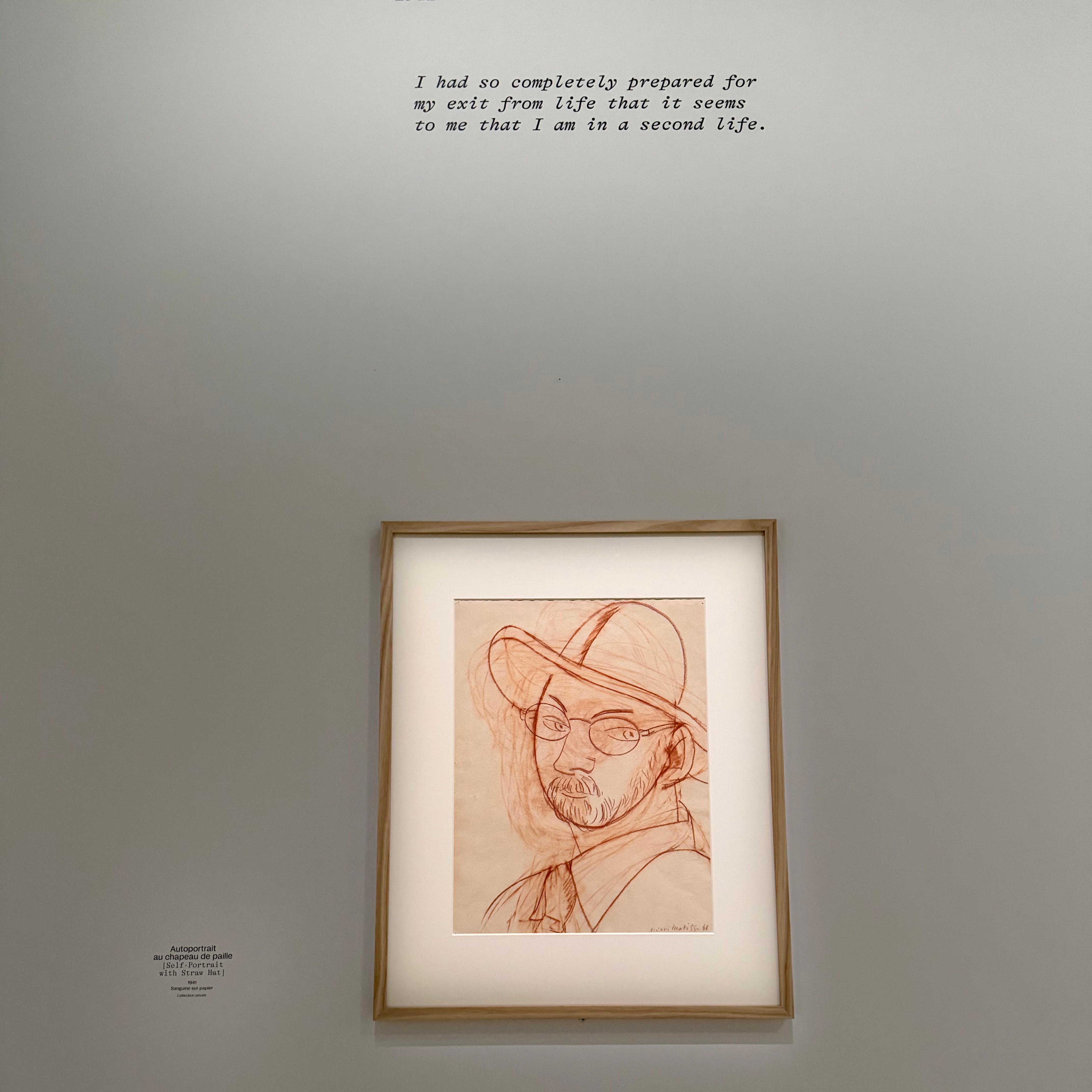
Rarely has an exhibition been so well curated, so justifiably attributed to an artist’s life that it makes you want to go back every day to stand close to each and every painting, every artwork, every expression of the artist, if only to see right through to their mind’s eye. And when you leave, it feels like you are leaving a part of yourself behind. The Matisse exhibition at the grand palais is one of such exhibition.
We were one of the last ones to be admitted into the show with just under two hours remaining and I would have stayed an extra two if the museum would allow.
Spread over three floors, and splendidly curated, you get the sense the artist is walking you through his life and talking you through his eras. There was the jazz era, I didn’t know Matisse had a jazz era for starters, the process upon which an art piece comes to fruition is fully examined here, paintings I did not know existed, I didn’t know he painted fruit! or could possibly have done. There are the cut outs of course, but I think, rather I know, the standout for me was the part of the exhibition that featured the church at Vence, alongside the video. This was the part that moved me to tears, because I love this church, it features in as story in the French riviera travel guide and it is one I hold so dear, one of the most incredible churches ever for all its simpleness.


This was an exhibition well thought out, and robust, one that was an ode and a celebration to an artist’s life; in it you see the works hailed, works not so hailed, works where he thought were not his best, works he strived to create in the last days of his life, and in there, in the crevices, a relationship with his faith and an acknowledgement of his mortality. A lust for the lovely things in life and possibly a man who sometimes had the intrusive thought that he never measured up to his peers… you see it all. The years of struggle through pain post-surgery, amid a world ravaged with war, when getting out of bed must have been such a chore and standing up to paint, impossible, Henri Matisee pushes through.
Centre Pompidou and Grand Palais came together to produce a feast for the eyes through the years the shaped the artist the most, painting after painting, era after era, stroke after stroke, cut out after cut out, this was a celebration of a local boy done good; particularly in the latter years of his life.


Upon entering the museum, you get a sense you are being pulled in through a small channel, like the mouth of a V because of the closeness of the space, then into the vastness of the space you go and you are sucked in. The works here are indicative of a time when the artist must have needed to forget the world he once knew had faded into nothingness; his wife and daughter were arrested by the Gestapo for being part of the resistance, the French Riviera he once knew would be no more after this war and so in the midst of a crumbling world, without knowing the fate of his loved ones, he painted. Or should that be obsessed as he painted the same characters over and over and over again, playing with lights and shadows and angles and planes to get right details he may have missed, and he works us through the process. In Sleeping Woman, a series of pencil drawing reiterating the character at rest, quite literally, there is a moment where you see it all come together, the crease between her eyebrows, the way her hair falls, the placement of her arms, even in pencil he captures the lightness of a being in a state of rest. He is obsessively repetitive to evoke a feeling, to the point of near madness it must have seemed, as he spanned the room painting the same subjects, whether he moved them around or they moved around. The more he added, the more he took away until you saw the nakedness of the person in the painting or drawing, felt the intention of the artist long after. He stripped down subjects, shedding of the baggage and leaning into a simplicity. He would draw and refine the same subjects and objects until they were simply lines, but in so doing was a fullness of being.


The cutouts are the Matisse we have always known, when his expression of colour took a particular artistic form; no paints, no brush but shapes and colour cut from paper, bodies, skies, leaves, animals… they tell an artist who is enjoying a renaissance almost creating a different mode of expression that would far outlive him and yet celebrate his own legacy. In his later years, I daresay this was Matisse at his best. He made cutouts like a jazz musician strung chords together to create such moving sound so much so, they would veer off note and throw something in the mix that would at once delight the audience and confound the other musicians playing alongside. The little red dot which I call the heart, I mean it is the heart isn’t it, in the cutout of Icarus, my favourite character in Greek mythology, is one such moment amidst plenty, that seem off beat but at its heart was in sync. So close to the sun yet his heart still holds.
In Vence his walls are plastered in cut outs, almost as if creating the perfect world to the one outside, Nice had been air bombed so he moved to the hills to get away from it all. His paintings here are also different so light it feels luminescent, simplified and stripped. The cutouts take on a life of their own, he becomes more ambitious creating whole landscapes in cuts out of bold colours, vegetal life in vivid hues. In the church in Vence, which I think is his most seminal work of art, he creates light in the shape of his cutouts on stained windows covered in plant motifs, priests vestments done in colours evoking something deep within, the drawings on the wall of St Dominic, the Madonna and child, stations of the cross… all communicate a yearning for the quiet so that you can hear the little voices deep within. To visit the chapel in Vence is to see a majesty at play. There are no grand altars, not gilded crosses, but there is a holiness to being here, if that is the right word. The light here is majestic and at an angle when the sun sets and it catches the stained windows… you can hear the angels sing.


Whilst the blue nudes have some to define the man himself, this exhibition pulls us into the facets of his life we might have forgotten about. I love the nudes, don’t get me wrong, but they have often overshadowed the narrative of a master artist who reinvented the wheel in the twilight of his life, when a world was slowly fading away, at personal loss, he came to the canvas every day and left it all there.


I’d been to the Tate in London and stopped by to see one of my favourite Matisse, the snail and it wasn’t there; it was always there, my nephews love that work of art. Of course, it was here, at the Grand Palais, home for a while. And it fit.
This was a celebration and a farewell postmortem of an artist who got his third wind later in life and created some of his very best works capped with a lasting edifice to glory in Vence. This is one exhibition you must not miss.
Matisse 1941-1954, at the Grand Palais until July 26th, 2026.