
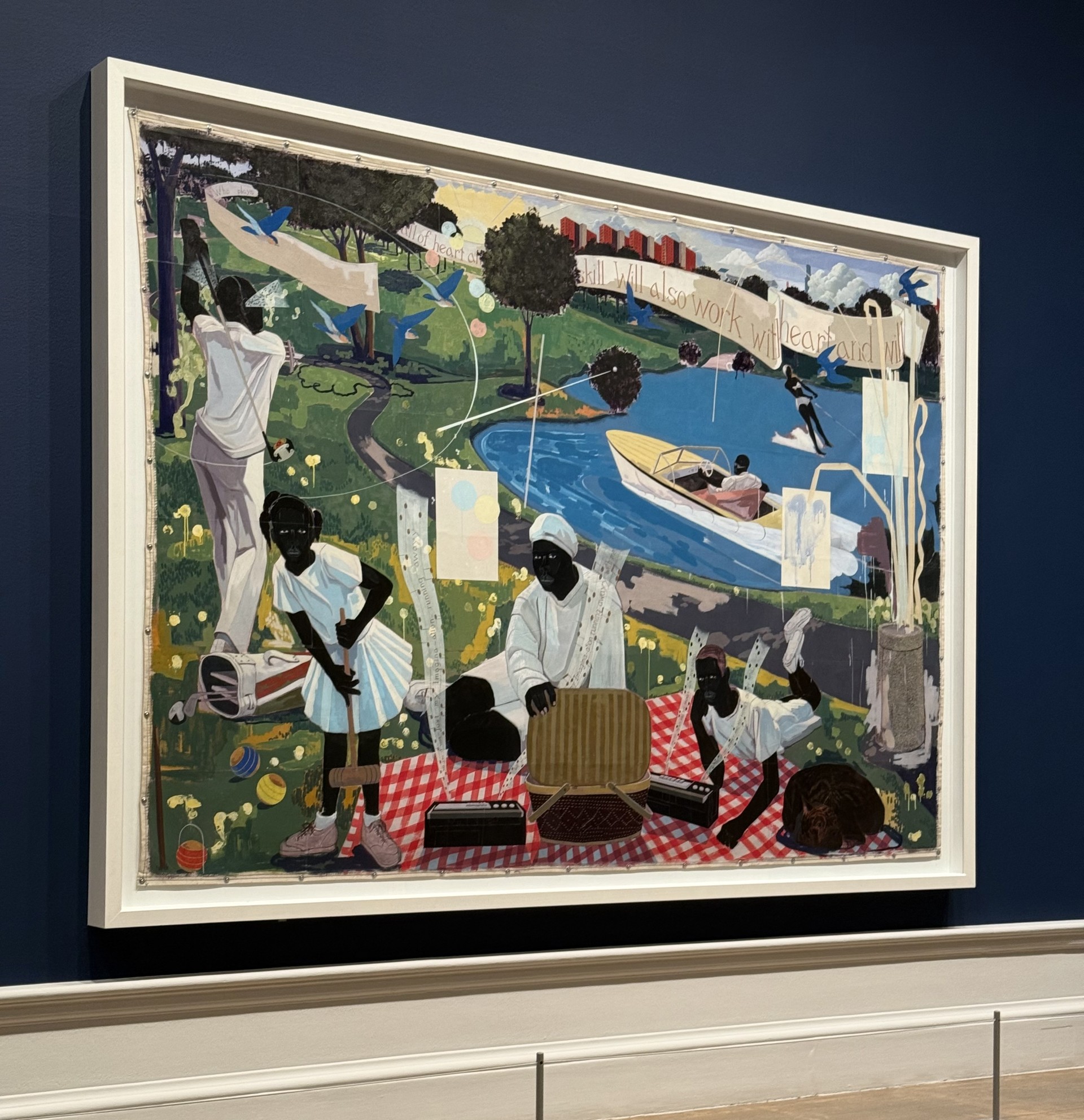
Blacker than black with layers of complexity and richness. Our history loud and full, quiet and beautiful. I couldn’t love this exhibition any more than I do, so much so, I saw it twice in one day then went back the next day to see it again. I stood in awe and was moved to tears. Kerry James Marshall is unapologetically beautiful in his work and makes us even more beautiful in our Blackness. It’s heavy yet light in its iteration.
We are lovers who protest those who question or humanities.
We are fighters with family.
We are mundane in everyday.
we are the struggle and the pay off.
We are happy.
We are sad.
We are good.
and we are loved.


Africa Revisited
The thing about Marshall’s work, besides everything else in the messaging and symbolism, is his use of colour. Black so black the undertone is non-negotiable; with most other artists you will spot the brown undertones to lighten the tonality, but Marshall is intentional, if that is a word to apply here for it feels so tepid a term. In his play on colours there is an uncomplicated showmanship on display. He lifts the canvas by simply having Black people at play, being ordinary in spaces, and in love but the symbolism of our history is afoot, the footnotes of our stories and the pivotal moments in our lives are ever so present.
Marshall sets about centring Blackness in all aspects of his work, in places where Black people were never once considered, whether it’s in the series The Academy, where both the artist and the observer are Black or in the series Painting of Modern Life where Black people are seen doing mundane things, but layers in these paintings reflects the migration from the south to the other parts of America, in search of a better life yet that life is in housing projects that struggled for resources. And yet they survived, this is a tale of their sheer resilience and an audacity to hope.


Much of this work centres on the audacity to be Black and thrive in spaces that felt like an anomaly, and in the face of institutions set to make life difficult for Black folks. In the Garden Project series, the works are reminiscent of Manet’s Luncheon On Grass, where, on a grand scale, the painter sets a scene of an afternoon picnic, where a group of friends are gathered… nothing complicated, perfectly mundane, hence Marhsall sets about centring Black people in such scale it is hard to ignore us even in the humdrum of everyday. There is a reasoning here too; Marhsall noted that often times when Black artists exhibit their works there is often a timidness to it, and in countering that he reinforces the importance for Black artists to create a Black figures in grand traditions.
He touches on the treachery of water in the Middle Passage, that medium of trauma which our ancestors had to suffer as they were taken from their homes to lands farther afield. A lot did not make it to the other side; they perished at sea; in the vast nothingness of it having never been at sea in this manner before. We see it still today, it prevails.

De Style is one of Kerry James Marshall most important works, a period that would come to define his prism going forward. We are in a barbershop; that most sacred of spaces for young Black boys and older Black men. Influenced by the Dutch movement De Stijl, it depicts a the scene in the barbershop, Percy’s House of Style; five young Black men, one in the barber’s chair two waiting to be seen and one presumably all gussied up. Behind the paper is the precision of organisation, cabinets and drawers, posters and a zenith radio, jars of potions and pomades and other hair cutting and styling paraphernalia which was in heavy rotation in the nineties when men took as much time styling their hair as women did; soul glo anyone? The hair styles are elaborate and showy, it was reminiscent of Marshall’s day growing up in South Central LA where young boys and girls were influences by the influx of movies depicting such. But it wasn’t only the style that was at play here, social commentary was on the mind. The calendar in the painting is set to April 1991, one month after the brutality of Rodney King at the hands of white police officers. As humanity is questioned in society, Marshall gives humanity to young Black men in abstract.

In Beauty School, School of culture the painting is set in a beauty shop is where Black women go to congregate, shed and reinvent themselves in all manner; it is meant to be our safe space where the community gathers and we can be ourselves but the standards of beauty are such that we may not fully be invested in our own identity because there is a barbie doll cut out to remind us that beauty standards often lies in the way of blondness per society diktat.
One of my favourite series is Vignettes, Lovers on canvas skin dark like the night but there is a warmth to it, of the bodies and a longing for more. Black couples in love, and Marshall seeks to understand if Black couples can be afforded the space to love and be loved publicly and peacefully without it being a form of resistance; each one of these paintings have an object of protest embedded in them despite the dreamy landscape and the frivolity of the couple portrayed.


Vignettes
His work with colours and symbolism are often at the fore front. Black lovers on page are not simply Black lovers but harbingers of black joy. The beauty shop is not just where we go to get a wash and go it’s a school of life.
He touches on colonisation in Africa Revisited, and the slave trade, the complexity in the matters of how these sometimes took place with the knowledge of those on the inside who swap human bodies for European loot. An underlying theme of greed is prevalent here, The killing of Shaka Zulu by his half-brothers; another added layer of complication when you consider the circumstances upon which these events unfold. History is complicated in its unravelling, and the onus is on the observer to decipher the truth even when it is counter to the greater narrative. At least this is what Marhsall challenges us to do.


Knowledge & Wonder


There is depth, layers, layers and layers of depth. There are stories; chapters and scenes of it in multilayered narratives that only WE can understand. I often wonder what people of other races think when they see works like these; what goes through their minds? Do they get the voracity of the work? Do they understand our symbolism that are being flexed on canvas? Do they see the criticisms when it is so pointedly, and subtlety aimed? But more important do they get it?
We lived. We live still.
We loved. We love still.
We live despite the desire to erase us.
We love despite the desire to rewrite history.
This is our story.
This is our song.
the gallery


Vignettes


Kerry James Marshall- Our Histories at the Royal Academy of Art, until January 18th, 2026