
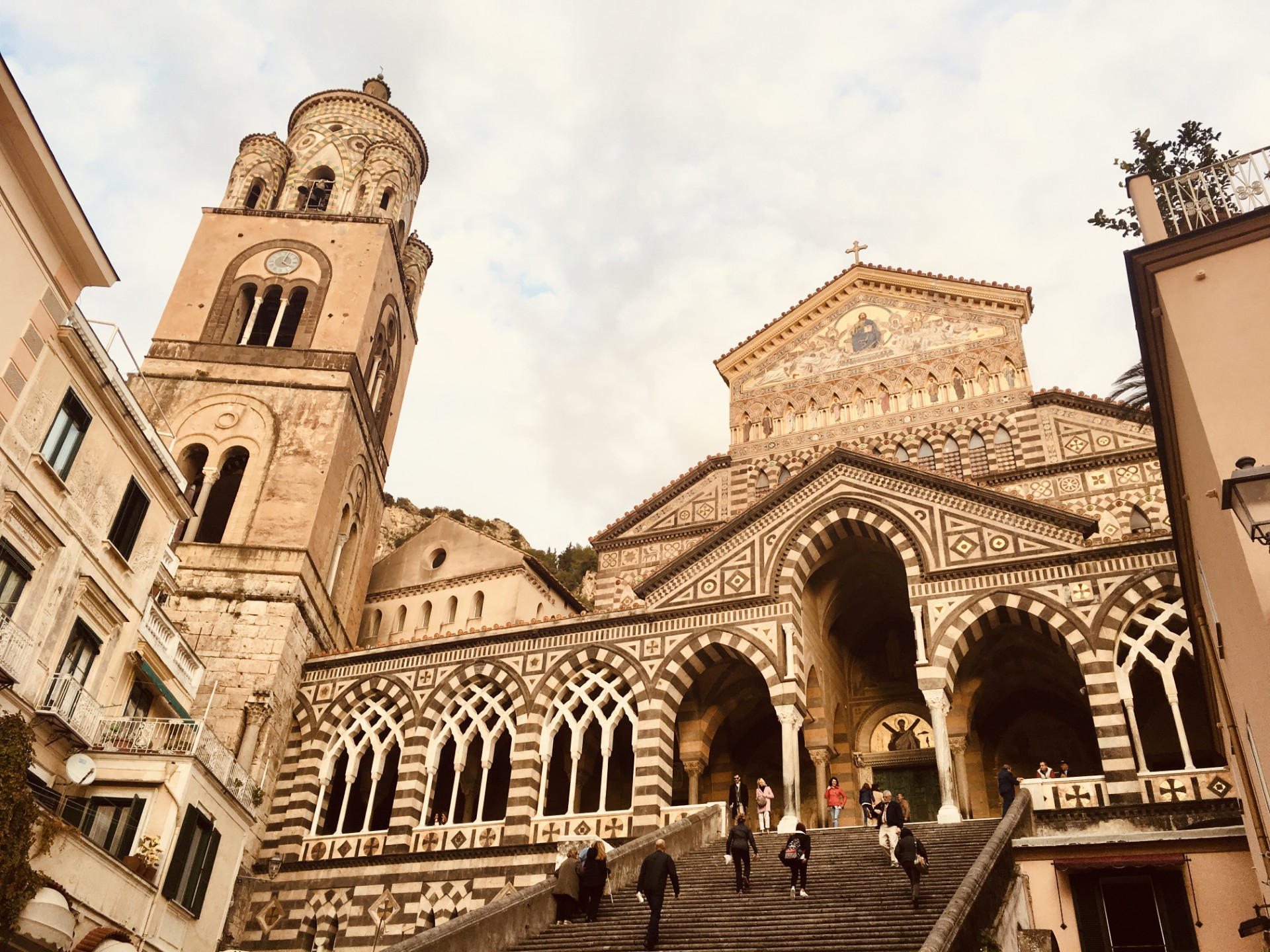
I have a vivid recollection of getting to Amalfi; on a bus from Positano, I think we could have walked it even but then we aren’t locals and the hair pin bends coupled with the fact that I do not know the lay of the land very well, did not leave me brave enough to try. But I remember arriving into Amalfi and wondering where I was for a minute and why it was so busy; it felt like spring though it was late autumn when we were sure the crowds would be thin. More fool us. I liked it still because there was a rawness in its charm. I came for the lemons.
In Amalfi we stopped for spices and were harried as we walked up to the cathedral. On the Amalfi Coast it is all sights and sounds, the smell of the ever famous lemons; did you go to the Amalfi coast if you did not have limoncello or bring a bottle or three home with you? You did not my friend, let me assure you, you did not. Those lemons ought to be protected because there is truly nothing quite like them in the world and I may not have been to every place in thew world, but I am inclined to believe this. As the kids say, it hits different.
Amalfi is a town that towns if you know what I mean? It is where most will go for the name and also because it is a hair much cheaper than Positano or maybe a whole head of hair. Something about it, a little something reminds me of Naples I don’t know what it is, maybe it’s the bus stop, the fact that our eyes race up to the very top looking at the black and white building or the blue waters OR the hyper activity… it is very Naples like and that may not necessarily be a bad thing. We were only here for a short while and will definitely be back. It presented us with views, and looked out onto the deep blue sea, the road there is paved with perilous turns but look out the window at one of the wonders of the world that has stood for thousands of years. Feel the siren call of Vesuvius in the distance, and the lure of Capri not to far away.


I know I said we come the Amalfi Coast to do nothing because well, there is a whole lot of nothing to do when you come here other than seek the glitz and the glamour and in high season… forget all about that because everyone descends on this famous coast in search of the very same thing. I would skip high season; I always do anyways and opt for early spring; March to the end of April, maybe mid-May and Autumn to the early onset of winter. It’s perfect. There is a heritage present in Amalfi; a town that is lived in and has remnants of the souls who have passed through, remained or returned. It feels like that. It’s the people and the many stories it holds dear, it’s the charm in the creases and it’s the heart of the Amalfi Coast…
Afternoons Like This In Amalfi:
Eat: to know me is to know that I love a good pastry, I will sell my soul for a good pastry therefore I was always going to go to Pasticceria Pansa here since the 19th century; it is a must for me. Most come here for the Sfogliatella I would happily live here for the delizia al Limone. You have never tasted anything quite like it. I promise you.
For lunch I would say Da Gemma Cantina for one of the best lunches of your life, the Ravioli here? It almost makes me never want to eat ravioli outside of Italy again. Simple and divine and oh so worth every bite.

Play: the paper museum; I am sucker for a paper museum and anywhere that has one will host me as a guest. I am enamoured by the art of making paper and this is one fo the oldest paper mills in the world still around today. But is is more than that. Before the flood of 1954 there were 16 paper mills in Amalfi and after the flood 3 were left. Today, only one of the last survivors runs as a mill and it is still helmed by the Amatruda family that reside in Amalfi. There is something to be said about family legacy that remains through the years, through the seasons and through the storms. That honest to goodness salt of the earth profession that connects the hands with the heart and that is what paper making feels like. It is the process not to be rushed it is the end result steeped in history. Rag paper has been made here since the 13th century and in Cartiera Amatruda, time stands still, it is not the click of the mice that serenades you, its the hum of machinery, heavy laden machinery that produces some of the finest pieces of paper. It is a lost art that is slowly coming back to life and I hope for the next 700 years it remains so and remains in the family that has its roots in it.


Duomo di Amalfi or Cattedrale di Sant’Adrea: what is Italy without a duomo or a thousand? An empty land and you know how I feel about a church therefore I will go to the church and be rooted in the history of the place. This one is rather special; it tells of the importance of Amalfi at the height of its empire with overlapping elements of the Moors, Byzantine, and Baroque all embodied in our building. It is steeped in the history of the place and the story of its past influences from trades with the mediterranean to the relics of its named saint, it is a testament to times past and the role it played in its maritime heyday. Without question it is the pride of the town not least because it is smack dab in the middle of a busy through way, and juts right to the top proudly showing off its byzantine connection. The bronze doors was cast in Constantinople. The church dates back to the 6th century, an annex was built in the 13th century when the remains of St Andrew was interred here from Constantinople following the 4th crusade called by Pope Innocent III to recapture the city of Jerusalem from Muslim control. I often say, the history of a place is rooted in its place of worship. Yes, St Andrew’s remains was stolen, let’s call it what it is, and now lies here… at rest? Who knows considering Manna is said to appear at his tomb; Manna is a dense liquid so who knows if the Saint is lamenting the fact that he was stolen from his tomb in Constantinople where Manna is also said to appear frequently… make of that what you will. But when in Amalfi do visit the cathedral.


Cloisters of Paradise or Choistro Paradiso: I love a good cloister for one simple reason, it puts on a show of the most spectacular play of light, and it is the most peaceful space you can ever hope to find yourself. For some reason, we the people, seem to behave ourselves in the cloisters of a church as if the souls long departed can hear us. The cloisters of Paradise in the Duomo is truly a magnificent place to be; paradise as it claims. This used to be the place where nobility were buried hence the name because you know back then it was believed that only the rich will go to heaven; see the kissing of the head of the one Thomas Beckett after his assassination, a thing afforded only to the rich in order to secure their place in heaven. Or was that a misnomer? Anyways, this used to be the burial ground for the very wealthy. The remains of the Byzantine pulpit can also be seen here, apparently a more intact one can be found the Duomo of Sorrento. To the left are some Cosmatesque fragments along with two first and second century sarcophagi one of which depicts the wedding of Peleus and Thetis. There are a set of stairs which lead to the Baroque styled crypt of St Andrew where his relics remain. Here is also where you will find two sculptures, St. Lawrence and St Stephen, by Pietro Bernini, father of one Gianlorenzo Bernini; THAT BERNINI.
One thing o come home with: Limoncello. How could you not? If you can swing it too; Amalfi Lemons.