
Ferrari. As far back as I can remember, I’ve had this thing for Ferrari and Michael Schumacher was my driver for the ages until Hamilton came along and it was a tug of war between the two because Schumi’s years in Ferrari are some of the best years in racing and I would go so far as to say Hamilton’s years in Mercedes the best of racing; certainly the winning years. But my heart has always belonged to Ferrari and now that Lewis is in Ferrari… I AM ALL IN BABY!
So come away with me to one of the most jaw droppingly epic places in Italy; the Ferrari museums. History, talent, legacy… and if you find yourself in Bologna, you most certainly should make the pilgrimage to the Modena and Marenello to walk the timeline of history of the most storied racing house.

Modena; this museum feels a little more intimate, more personal, than the one in Maranello, because it tells the story of Enzo the boy from birth to the man he grew up to become. Established in 2012, it is dedicated to the life and career achievements of Enzo. There are two buildings here, the traditional house where he was born is semi-encircled by the modern museum emblazoned in that Modena yellow. Here we meet Enzo, a Pisces like me, HA! Please I am sucker for creatives of my kind. He is obsessed with cars from a young age and in the early 1920s he becomes a driver from Alfa Romeo, quickly climbing the ranks off the track too in the company. Post World War II, Enzo Ferrari founded Ferrari SPA in Maranello; the prancing horse on a yellow background was the inspired by Francesco Baracca a pilot in WWII. The logo embodies all that Ferrari is known for: horsepower. Let’s be cliché here, speed, and that uncompromising strength.
This museum is where the story of Enzo Ferrari comes alive, outside the racetrack outside the need for speed, here is where his passion is put on display, where he wears his heart on his sleeves, so to speak. The home where Ferrari was born is preserved through the ages in such a way to honour the story, but here is also the beating heart of who he was, it is a museum of some of the most iconic engines that have powered it to victory over the years; and also a clever juxtaposition of the brand as it was and its evolution through the years.

The day Enzo Ferrari was born was said to be remarkable, snowstorms hit Modena in 1898, and it would be two days after his birth that his parents were able to register him on the 20th of February, don’t worry, that still makes him a fellow fish, they are not taking this one from us. The boy would become the measure of the man he was always going to be, if the weather was any indicator that day. There were other famous Modenians? Is that what we call people born in Modena? Modenistas? I am not looking this up… not least, one Luciano Pavarotti, but the added thing about a need for speed would absolutely put Enzo Ferrari in a class above the rest; I mean Pavarotti is too because Enzo couldn’t hold a note to the Tenor, but The Pope of the north was what they christened Enzo because Ferrari is to Modena what the Pope is to Rome, if that is a fair analogy.
I suppose what is so auspicious about Enzo Ferrari, is the fact that however big he grew, he remained close to home; confident in his being that they would come to him and come they did. He did not find fame and fortune and then quit his small town, he remained the local lad done good, lauded as the king. We go to Modena because we are drawn by Enzo’s legacy. There may be other things there like Olive Oil and Balsamic vinegar, but Enzo is the draw, he always has been. Even if olive oil is “liquid gold”.
Visiting Modena is akin to stepping into Enzo’s front room, a town that never fell out of love with him in life or death. Modena is surrounded by car manufacturers, but the core of the town, remains as beautiful as it is reticent; if there is one thing I know about Italy, it is their power of preservation because these cobbled streets, these old palazzos, these pastel coloured buildings and patina, tell of their greatness, reveals the true story of their legends and these are the streets where greatness roamed; Enzo Ferrari was here.
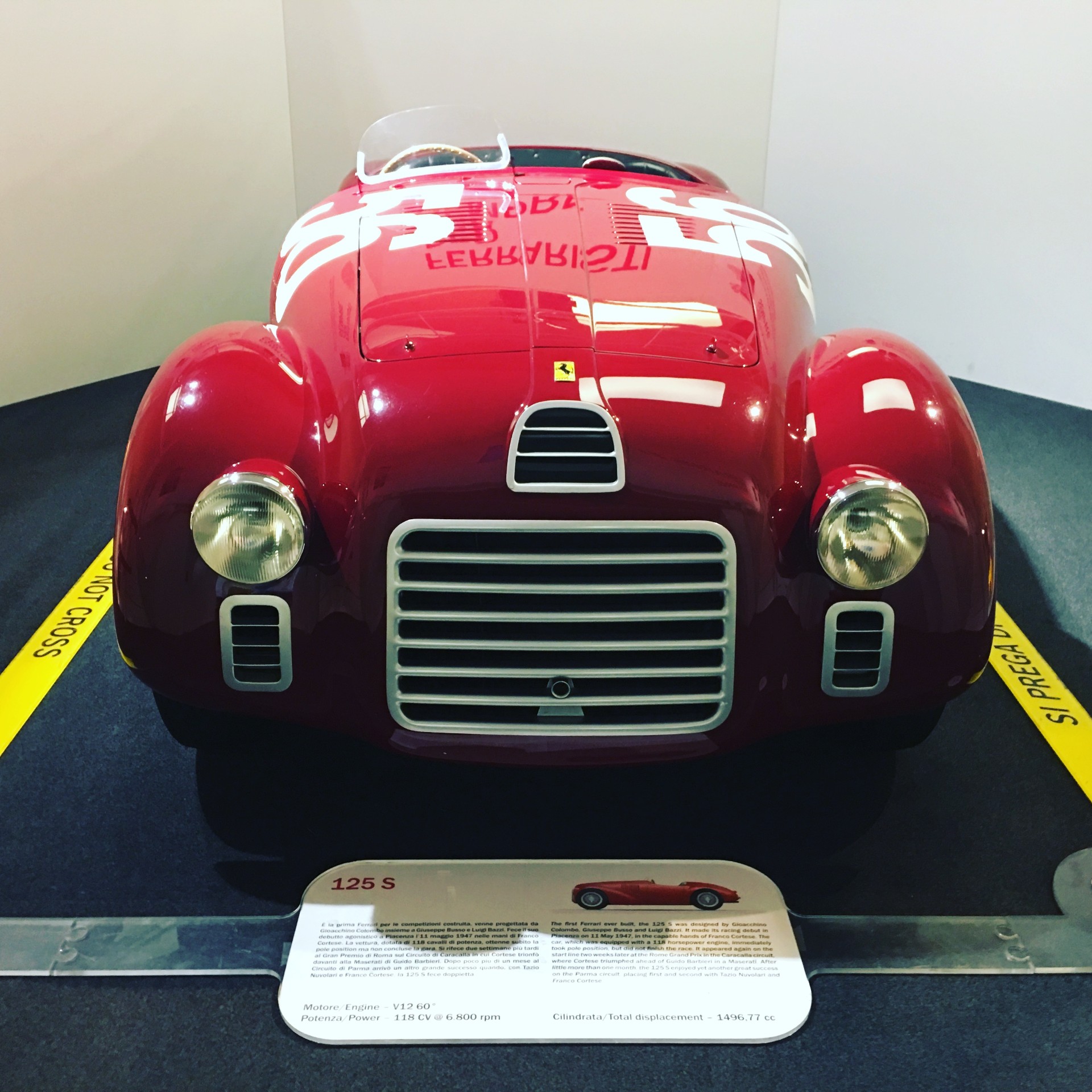
The first Ferrari appeared in 1947 two or three years before the first formula one race. Enzo started his racing career as a driver for Alfa Romeo but as it often the case in these situations, he was a better businessman than driver and he would head up the first Scuderia Ferrari whilst working in Alfa Romeo.
Much has been and will always be said about the story of Ferrari, but the home where he started his life is one worthy of a visit. This is the story of the man himself; architecture and history; the old farmhouse in the shadow of the architectural marvel that is the museum. In 2005, following a competition the late Jan Kaplicky was commissioned to build the museum; his idea included sculpting an exhibition space alongside the old farmhouse, juxtaposing old alongside new, but in a way where homage is paid to the racer and his roots. Kaplicky died in 2009 before construction began and Andrea Morgante, the ingenue, stepped in for his mentor.
This building is magnificent, sleek curves like a Ferrari with that Modena yellow on the roof with ten openings that look like gills, impressive to see it from above. But even more so approaching it from the ground. It feels hallowed almost, approaching the traditional farmhouse and then seeing it enveloped by the modern exposition of the new building, with its glass curved wall that feels like it is reaching out to the old building that houses the heart of the marque; the engines.
It is as emotive as it is melancholic; that the old man isn’t here to see how far he has come but his worlds have come together and that is the knowledge we are comforted by.
Sentimental enough?


About twenty kilometres from Modena is the other Ferrari museum in Maranello. Both museums are good, like really good, but in my opinion, because I know this is where people can come for me, Maranello is pretty hard to beat. Modena has the added bit of history to it because it is where he was born and blah, blah, blah, but Maranello packs a punch. There is something reverential about this space, its big but it also feels especial, and genius is the word that comes to mind when you walk the breadth of this place. Pure genius that precedes its time and lasts for generations, one of such uniqueness and forethought that viewed in the present day, simply astounds. The first ever Ferrari to leave the garage is on display here. How’s that for packing a punch.
This museum houses history that stands the test of time.


If the museum in Modena is the embodiment of the man, The Ferrari Museum in Maranello is the temple to the man; the place where you get the measure of his greatness. It takes you on a capitative journey through the brand and through time. It is an evolution of a brand from the humble beginnings in Modena. Where the factory in Modena shows you a fraction of that beginning, Maranello takes you through the futuristic journey. An immersion of where the trifactor of technology, design and perfection marry; the holy trinity if you will, of automobile and you just cannot help but think they don’t make them like this anymore. And they really don’t. I don’t care what Tesla is doing, it is will never equate to this.
The museum was founded in1990, and it chronicles the chart to success of the brand; you can see every influence of Enzo Ferrari in and around the museum. This is the epitome of what it means to be excellent; it’s passion you see, passion that sips through every inch of that museum, a relentless passion and devotion to excellence. Take the Hall of champions for example; if anywhere iconises the greatness of Ferrari it is this hall; encircled by a Wall of fame showcasing its many trophies of the good and greats and a dedication to the goods and the greats that have driven for the house/ Alberto Ascari, Juan Manuel Fangio, Mike Hawthorn, Jody Scheckter, Kimi Räikkönen, and of course, Michael Schumacher who won with Ferrari total of 5 times. The epicentre of this hall is a semi-circle of its winning cars, most of which were Schumacher’s car. Even more so, in this present moment, it is as pertinent as ever, it gives you goosebumps just being here. This is a house that will forever remain a legend. It is possibly one of my favourite spaces in any museum in the world, because you are swept up in the histories and the stories that have accompanied the victories and on such a high octane. Here you see the exceptionalism of brand Ferrari.
Also present in the museum is the iconic 250 GTO if you know one thing about Ferrari it is that this car is the pinnacle of its superiority; the craftmanship, the exceptional longevity:


But here, I have some more facts for you, courtesy of Sotheby’s:
- The GTO is the world’s most important, desirable, and legendary motor car: coming from a house as Ferrari how could it not be legendary.
- There were only 36 GTOs and they are the rarest and most expensive cars to acquire. Think upwards of forty million at auction and even more so privately.
- The version driven by Edoardo Lualdi – Gabardi in the Italian GT championship in 1962 sold for upwards of 48 million at auction.
It is without question one of the most prized classic cars in the world, a singular showcase of automotive design and engineering. I know nothing about engineering per se, less even about cars, but I have given a fair bit of time to studying brands like Ferrari and being obsessed with what has made them one of the greatest, certainly the greatest in moto-racing.

If there is a symbol of its pinnacle, for me it is a toss-up up between the GTO and the very first Ferrari to have left the garage, and it is hard to top the first but equally as hard to top the best, both are here. So go see them because they are a testament to craft, design but above all else, an exceptional obsessiveness and passion. Enzo Ferrari embodied that, if a little too much. I won’t bore you with the rest of the details just to say it is as impressive as any car never was and to be in the presence of one is akin to the best orgasm of one’s life… or so they tell me.
So, of the two museums; Maranello is the head, all work and sex appeal with dreamy eyes, but Modena holds the heart; melting and swoony. Both spaces hold and are worthy of a visit.