
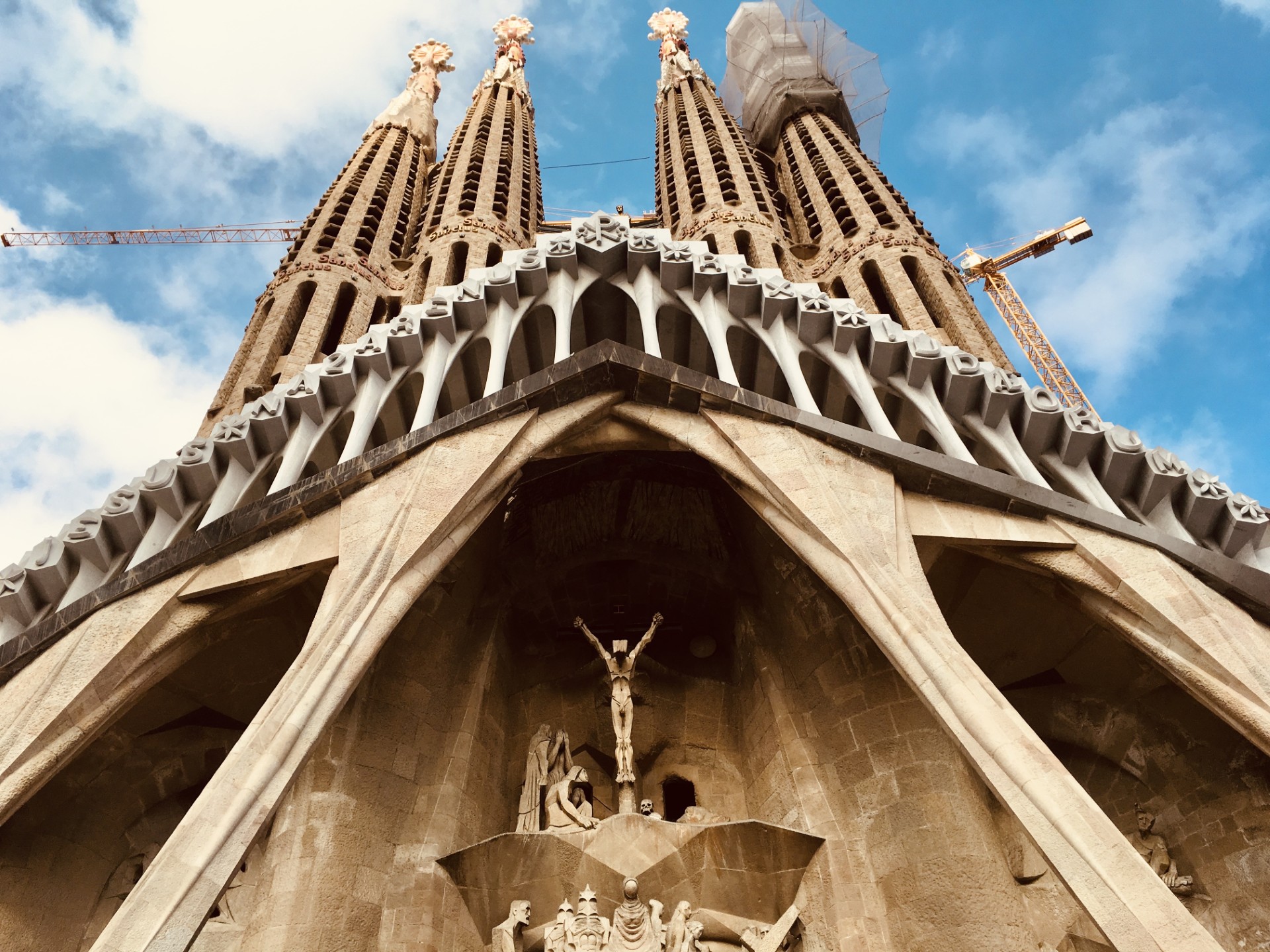
This is the most magnificent church, THIS IS THE MOST MAGNIFICENT CHURCH, IN THE ENTIRE WORLD. QUOTE ME ON THAT. And it is not even finished yet. It has taken over 100 years to build, and is now in its home straits, they promise to complete by 2026. The story of La Sagrada Familia is as much about the architect as it about a humble sense of self and the limitations of one’s mortality.
Antonin Gaudi was a master among us. A man whose work only adds more, so much more to the landscape and history of Barcelona, of Spain, of the Catholic Church at large. He knew he would not be alive to see the completion of this church and so he left behind his instructions and vision trusting that those coming behind him would capture the essence of it all.
It is truly, truly, the most magnificent church. A wander of the architectural world that one ought to see once in their life time. I loved the church before I saw it and I love even more each time I see it, because what Gaudi set out to create was a grand church but without the grandeur and in doing so, alludes to a spectacularly humble story of a man’s deep connection to his faith and a deeply abiding love for it. This was bigger than Gaudi and he knew it; it takes a certain type of human being to know the limitations of his ability before they present themselves to him.


The exterior, through the interior, and out the back of the church touches on the anchoring tenets of Christ’s life; a cornerstone of the Church. From the birth to the passion. There was an important consciousness to connect the earth to religion- the interior is shaped like the amazon forest; tall pillars that remind one of tree trunks with branches that fan out into the nave to form a canopy of tree branches as one would find in the forest. As grand as this church is, it deeply, deeply intimate and deeply moved by the faith of its creator who had a profound respect for the earth as a footstool.
The initial plan of the church was another gothic style cathedral as we would come to find in Europe at the time, it was designed by Francisco de Paulo de villa but the design was dismissed when it was found it would cost too much to build, (talk about irony eh) and the project was given to a young architect who was fast becoming a cult favourite, Antonin Gaudi.
To understand the church, one must understand the mind of the man who would conjure up such a place. Gaudi was on the cusp of great things his style which included a lot of fluidity, curvature and an unusual yet natural rhythm without straight lines, attracted the very well-heeled in society. At the time of his graduation from Barcelona’s school architecture the rector Elies Rogent is quoted as saying
“I don’t know if we have awarded this degree to a mad man or a genius. Only time will tell.”
And time did tell. His first commission was Casa Vicens the summer home of the Vicens family. Esuebi Guell became an early patron of the architect amongst other well-heeled members of society and his newfound celebrity would earmark him for what was to be Barcelona’s most famous and lauded landmark even before its completion.
It’s been 84 years… well over 100 actually but who is counting? 140 years to be precise so we are obviously counting but they promise it will be complete by 2026, 100 years after the death of Gaudi. Which is perfect.
The vision of Gaudi feels eternal, his work often typifies form rarely ever seen, he saw shapes in the most peculiar of ways, there is fluidity in his form; he was both a mad man and a genius. 100 years after his death that fact holds true, the church he envisioned, yet knew he would never be around to see its completion, is a testament to his mastery, it remains a masterpiece that was well ahead of its time, even today it feel transcendent.


The façade of the Sagrada is ornate, intricately so, capturing detailed stories of the beginnings of Christ life, 56 columns branch into each other with an array of shapes and figures, stained glass windows and phantasmatic elements. It is unlike any other church, that would include the Basilica of St Peter’s in the Vatican. Fight me.
The front is the nativity of Christ, and the first bell tower to be erected is dedicated to St Barnabas was complete in 1625, this was the only structure of the church that was complete when Gaudi met his untimely death after being hit by a tram a year later. He is buried in the crypt of the church.
The etymology of the church:
The Nativity Façade: faces the east, because the sun rises in the east, the nativity is the birth of the son. It was constructed between 1894 and 1930, when you think about it was not that long ago actually. Three portals make up the front facing façade the portal of hope is dedicated to Joseph, the portal of faith dedicated to Mary and the central portal, charity is dedicated to Jesus. There are scenes of the Nativity, of nature, leaves, flowers, manger animals, bugs. A tree of life is surrounded by marble doves. The façade is meant to tell a story of Christ’s birth and its significance to the redemption- the birth and by extension the promise of God to the Church. The four bell towers are dedicated to four saints: Barnabas, Mathew, Jude and Simon.
The Passion Façade: to the rear of the church is the scene that is the most important part of the Church; the passion of Christ which is to the west of the church; the sun sets in the west, this is the sun setting on the first part of the life of Christ. Gaudi left detailed drawings of his vision for the church therefore the construction was guided by him post-mortem. It was completed in 1976 after 22 years of construction. This façade is markedly different from the nativity; where the first is full of the promise of life, the spring of Christ so to speak, this façade is more solemn, the winter of his life if you will. It is more austere, Gaudi wanted to represent the suffering of Christ to the bare bones of the skeletal structures. It is the final station of the cross; Christ hanging on the cross. The façade has 18 bones shaped columns atop other columns shaped like the sequoia tree trunk and shrouded within Christ on the cross crowned with thorns. The scenes from moments leading to the crucifixion, calvary and death.
Standing apart and taking in this scene, the starkness of it when compared to the fullness of the nativity and walking through that glorious church is quite something. It is almost as if you are at the very essence of the Catholic faith. I have always thought of the passion as the most important part of the church simply because it is a promise fulfilled by God the father, a covenant upheld, and resurrection of the body and life everlasting. That would be my Sunday school teaching showing up for the win.
The Gloria Façade: knowing he would not be alive to see this completed, Gaudi drew sketches of what the Gloria should be. Still under construction and has been since 2002, it is the tallest of the three facades and it is connected to the central nave representing Christ’s ascension into heaven and the scenes of eternal glory. On completion this will constitute of five columns that will be dedicated to seven deadly and holy gifts. At the top will be seven heavenly virtues. The entrance will also represent virtues of the sacrament: baptism, confirmation, eucharist, penance, holy orders, marriage and anointing of the sick.


The Interiors: ever the nature lover, the interior is Gaudi’s ode to the supremacy of nature above all. There are 36 columns that race to the very high ceilings giving an illusion of being in the forest. There are 5 naves and 7 chapels, the alter is illuminated by reflections from the stained glass windows. This place is chuck full of biblical symbolism; the entrance is that of virtues of love, hope and faith and the columns are reminiscent of saints in ascension whilst angels descend to meet and welcome them. There are four columns dedicated to evangelist, apostles, 15 Spanish cities with archbishops, four Catalan bishops and the five continents of the world. The stained glass windows are some of the most spectacular I have ever seen, great sources of light for the church, they are not simply pretty colours, they also contribute to the stories on the façade. Yellow, blue and green represent the nativity, orange and red represent the passion and resurrection.
Take a moment and follow the columns behind the canopy, the mosaic dome is a story of Christianity. Everything about this church is inspired and inspiring. And I know I have said it before but I will say it again it really is the most spectacular church and I would go so far as to say in the world, but I haven’t been to all the churches in the world, trust me, its on my list.
Nothing anchors the soul of a place like a place of worship, and I am fascinated by them and if there is a church with some sort of history or rendition of a bible story, I am so there.
Elements of nature elevate this church in many ways elevating mother nature to the role of the supreme, and acknowledge her as a creation from God. Gaudi believed in elements of nature, along with mathematical calculations, guided the construction by deployment geometrical patterns and elements of nature he fused both worlds into one, acknowledging the symbiotic relationship of both to life. He avoids straight lines here, because it is rare to find such linear reproductions in nature, lines curve and follow natural paths, straight lines are too pristine and finite and too perfect. The columns are the tree of life with branches that fan out at the nave guiding our line of sight. A rather interesting element are the turtles and tortoise representing land and sea, arches, and conoid roof, honeycombs, animals, ladybirds grass… but the most interesting element, I mean everything here is interesting, but the most interesting and unique is the canopy decorated with grape vines that form part of the alter… I’m telling you; SPECTACULAR.


Light! LIGHT! And more LIGHT! Celestial! The light show here is stupendous, absolutely. And this above all else, is what I am stunned by each time I visit, it entraps you in a particular kind of bliss. The stained-glass windows are large and vibrant cascading and bathing the scene in a translucent glow during sunrise and sunset. That symbiotic dance between natural light and the elements outside the church there is that calm stance between the tones that creates that yep, celestial atmosphere. You have to be here to see it and live it because it gives you a sense that Gaudi reached out and touched the cheek of God causing him to smile ever so fully because if any place on earth is an indication of the smile of God and his angels, I think this is the place. Angels tread here.