
On first sight, Bath is like any other town, big enough but not quite, its got an Abbey and that does count, but stay a while and you really note how utterly lovely the spa town is. It was a town only for the rich to spend their winters, because the water was heated and the town had that unique something that was rarefied. Our tour guide informed us of the lunacy of how pampered the wealthy were back in the day; if we ever find ourselves regressing into the 18th century, aspire to come back as a rich person, a really wealthy person because they were superiorly indulged. Picture this, to get to these heated pools, they would be carried from their homes in rented Sedan chairs for a fee, and then after a day spent by the pool, would be carried back home, right up to their bedrooms.


The pump room is also where arranged marriages between the aristocrats were contracted. Here you would have rich people come in for a glass of cold water, because I guess back in the day this was a thing, walk around chatting to other rich people and introductions would be made, and before you know it, the marriage has been gazetted between two rich families… talk about a smooth operation.
But I don’t want to write about Bath the spa town, this has been written and rewritten, I want to talk about the King of Bath, the man who made Bath what it is today… Beau Nash; a man worthy of his legend. I love his story and I think everyone should know his story, even if some of it is disputed, it is an urban legend that lives on and is one of the most tantalising tales about any one person who ever lived. Tales of self-made people typically are because they are willing to push the envelope of the norm.
Beau Nash was Vogue before Vogue was a thing. Even his name sets him apart; he set the trends and made Bath what it is today. When he died, no one really knew how old he was, his neighbours said he was 86, his obituary said 87, the gun salute was fired 88 times such was the legend of this great man his age did not matter, it was simply enough to know that he lived. He brought, eyes, ears and money to Bath and rubbed shoulders with aristocracy and royalty. He would latch himself to the entourage of any travelling royal and finagle his way to prominence with them. A bit or a lot of a rebel, he came from nothing and made something of himself; defined an era in Bath that still is today. He was a chief event curator for all of Bath and made a killing in the season.


I think my favourite story about him was when gambling, was outlawed, he could no longer afford his home, which still stand today, complete with his own sigil, he moved next door to live with his mistress, the “handsome and faithful” Juliana Popjoy (someone ought to write a historical that adapts their story and I want their happy ever after.) Beau and Popjoy, sorry I will not be referring to her as Juliana because Popjoy is such a fitting name for her, spent the rest of their lives together, until his death in 1761 at age 86, 87, 88… the building which they lived still stand today along with the plaque that immortalises their life and love story. Sometimes she roams around the building today, dressed in grey, making sure the new stewards maintain her high standards of entertainment as she did those many centuries ago.
A TALE OF SIX GEORGES, ONE FRED AND AN ELIZABETH
QUEEN SQUARE is a square surrounded by Georgian houses heralding the Georgian and new world era of the sorts that enveloped Bath with John Wood’s style of new architecture and it is wrapped up in the tale of six Georges and one Fred. There’s a reason why Bath is known as the Georgian town because of the King Georges. Now if Frederick hadn’t been hit by a cricket ball and died, there would’ve been an interruption in the George procession because Frederick was next in line to inherit the throne from his father King George II therefore on his death his son George III would go on to inherit the throne on his Grandpapa’s death. It is no wonder George II’s father of Frederick did not name his son who would be king George, they argued all the time,
Let’s take it from the top shall we; George I arrived in London from Germany following some kerfuffle with his wife that would see her imprisoned back in Germany, because she had an affair with a courtier who was killed. The king arrived in London with his two mistresses. He didn’t much care for the country though and didn’t spend much time in it, his disdain for England would lead to a decline in the influence of the monarchy. He died in 1727 and was buried in Germany.
George II the last king to lead the British regiments into battle was somewhat an improved version of the I, but he did not have a good relationship with his son Prince Frederick. Much like he’d had with his father. Following the death of Fredrick after an accident with a cricket ball, his grandson, George III would ascend the throne upon his death.

George III had a more illustrious reign having survived various pivotal wars that dwindled the power of Empire abroad, including the War of Independence in America. However, in his later years, he became afflicted by moments of madness (see Queen Charlotte, also listen to the podcast episode here) which, when eventually known, meant his son became Prince Regent and then King George IV on his father’s death. The IV was not a remarkable King, he was more interested in a life of debauchery and was embroiled in a messy divorce with his wife Caroline of Brunswick.
George V was also not expected to ascend the throne, his brother Edward who would be King died unexpectedly. Hence the Georgian era continued with the more progressive George V; he delivered the first Christmas broadcast on radio in Christmas of 1932. It was he who changed the family name from Saxe-Coburg-Gotha to Windsor during WW1. He also predicted the wayward behaviour of Edward his son, that would lead to the reign of George VI. Edward of Wallis Simpson fame who would have been Edward VIII abdicated the throne. “That boy will ruin himself in twelve months” his father was rumoured to have said at the time. Well, a parent always knows.
Enter George VI the late father of the late Queen Elizabeth II whose era would end the Georgian and usher in the Elizabethan. The VI was shy and introverted thanks to his stammer. He would rule England through WWII and severe austerity and rationing.
His death at 56 saw his daughter, Elizabeth II, Queen at the age of 25. It will be a while before we return to the Georgian era…
QUEEN MARY FRONT, MARY ANN BACK
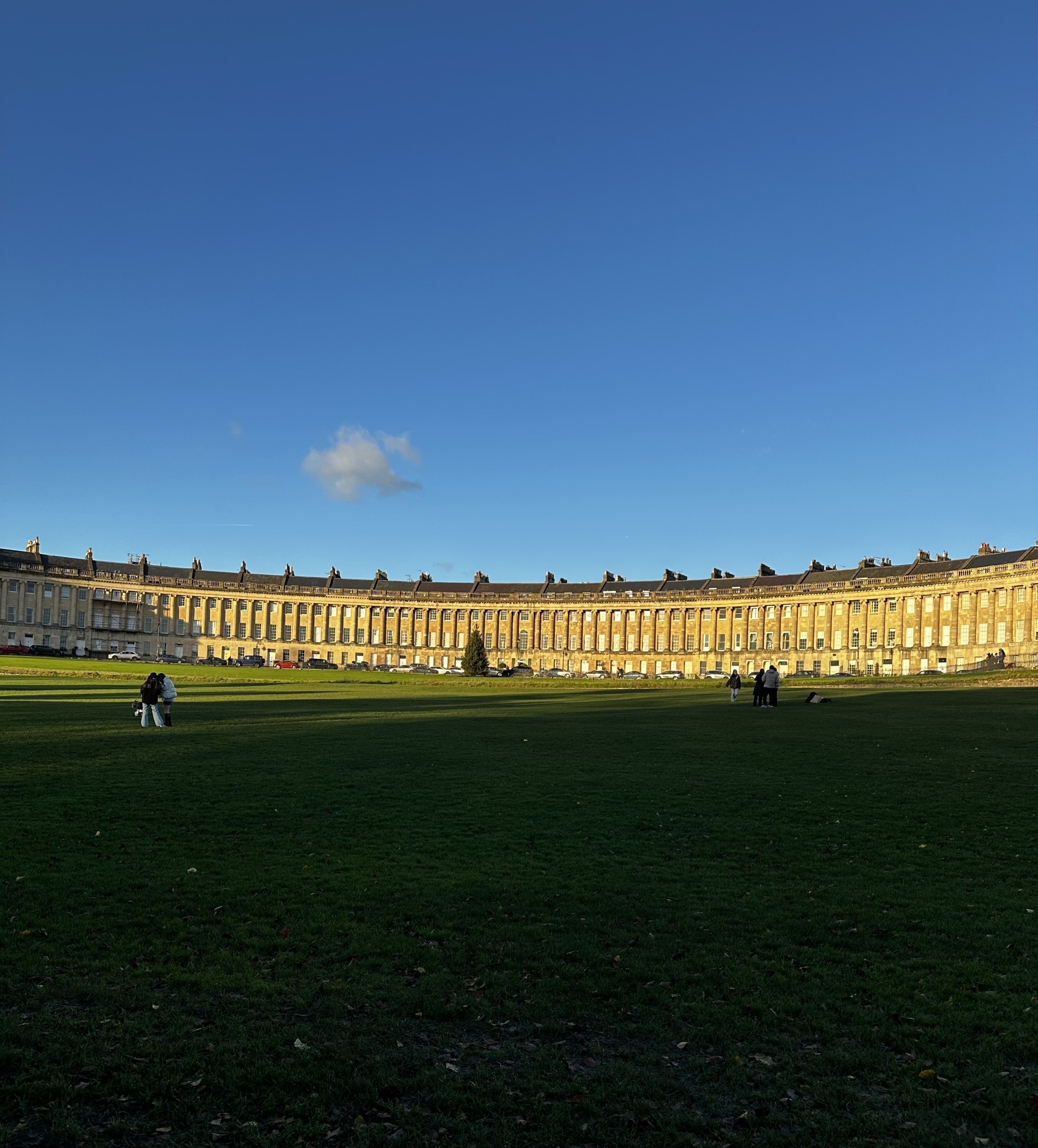
THE ROYAL CRESCENT: On my first visit to Bath, more than ten years ago, I fantasised about an apartment here, and several visits later, I still do. The Royal Crescent is a Grade I listed Georgian curved row of terraced homes and, now, a five star hotel, that informs of the urban development of the day in Bath. Built by John Wood the elder, the front garden landscape also includes a ha-ha wall that only adds to the grandness of the estate, each building separated by columns. This style of building, palladium style, was introduced by John Wood who developed Bath outside the old city walls. He was famous for maintaining a pretty façade but everything else was out of symmetry; Queen Mary front, Mary Ann at the back, is a famous saying that typifies this type of architecture feature where most houses built in the palladium style did not mirror the uniformity in the front the rest of the house was constructed according to the owner’s taste and affordability.
Completed in 1774, the Crescent remains one of Bath’s most identifiable and more defining architectural feature, Perhaps what is more interesting is that the interior of such houses, typifies the level of activity within the house which is often always more important: it is where servants are, where the kitchens are, where delivery would often have taken place back then… it tells of life and its many iterations from house to house. It is Mary Ann who is the Lady’s Maid to Queen Mary, presenting her to the world, without a fuss, whilst all the fuss is made at the back of house. Its like swan gliding regally on the pond but we don’t see are the feet peddling madly.

ROYAL CRESCENT PARK: beyond the Ha-ha wall, so named because of the surprise, of the person coming up on it, is simply a sunken fenced wall that separates the two patches of lawn. On a wonderful summer’s day, this is the perfect place to hang out for a spell, if you can, have a picnic here… yes I am fan of picnics and this is peak picnic season, so grab a spot in the sun or the shade and bask in the glory of the crescent. You also get the pleasure of seeing the most expensive windbreaker buildings in the city. A row of houses that were build to stop the stench of the pits wafting through to the residents of the Royal Crescent. Back when we didn’t have toilets, people used chamber pots and these would be emptied out daily on farmlands for manure, not too far from the crescent, hence building these other houses on the edge, stopped the smell coming through… but now they cost an arm, a leg and then some.