
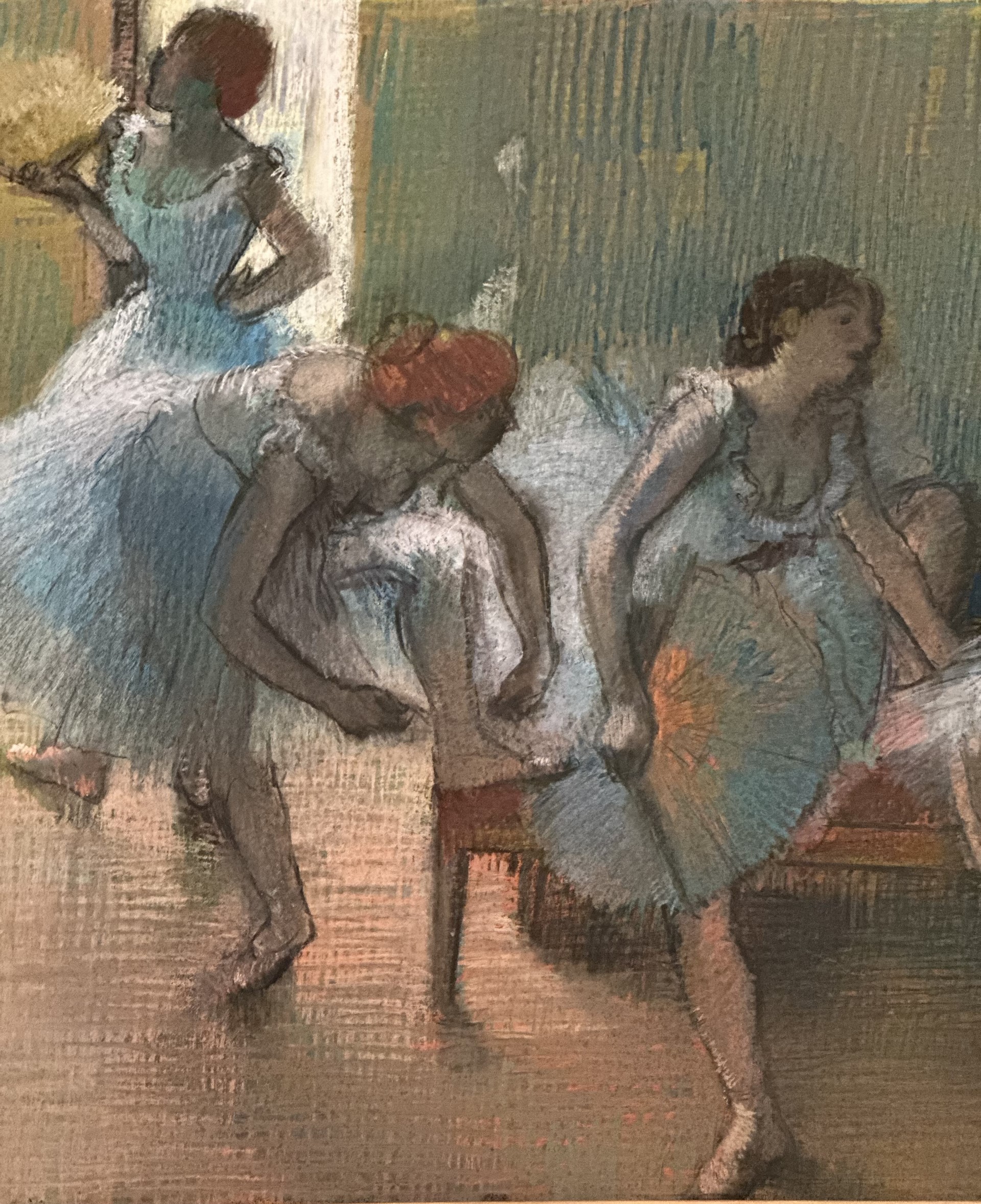
I have never not been in my Degas era, because I love his work, most everything I have seen of it. Matter of fact on my bucket list is an acquisition of a Degas sketch because I love how he conveys romanticism within the slight of his pencil. Degas captures a softness that comes with movement especially in his ballerina series; I especially think masterful, his capture of ballerinas off duty backstage a more sublime image you will be hard-pressed to find. As is the current exhibition at the Royal Academy of Art cascading Degas, Cezanne, Lautrec, Van Gogh and a few other from the impressionist movement.
Once upon a time, imaginations ran wild on such a slight, their subjects, be it mountain views from a studio in Provence a la Cezanne or Ballerinas, or a night at the moulin rouge, or a brief glimpse into a moving carriage… this exhibition reminds us that once upon a time the impressionists were masters.


Where their strokes were once thought of garish and possibly too much and gauche even, today they stand still as tall because their work is always a reference for the artists that came after them. Each movement has its era and not all will be understood but what we have here is a moment in time that reminds us all art, subjective it may be but impressive it absolutely always is, no matter your interpretations of them.
These were observations of everyday life and a capture of the modern world as advances interfered with life. Like a glimpse through an open window of a carriage the zipping by with two women unaware of their observer without. Sexual and voyeuristic, they went into brothels, and bars, captured cabaret shows in full swings and ballet performances in intermission.
Women in the marketplace chatting about everyday things with a solid juxtaposition of meat, wooden tables, and carving knife between them. This work by Camille Pissarro is one of my favourites from the exhibition because it centres on women doing everyday things; here it’s a scene at the market, a wooden table with pieces of steak between them and a large carving knife. Her fists rest on the table, we see the back of the proprietor, the colours of her garment are soft amidst the typically masculine representation, blues, whites, and whips of red, the materials softly caressing her body, the scene is not arranged or posed, it is rather casual but… solid is the word that comes to mind. Her patrons are finely turned out and in the distance are other women chatting and carrying on. I love this scene; it is unusual for the time a time when women were presented like porcelain dolls and dainty creatures.


Impressionist on paper seeks to answer that question that has rolled around the art world for long before we came to understand it; that capturing life on paper provided a more intimate rendition than on canvas. Paper was more readily available and easy to cart around than canvas and there is a connection that makes it more quixotic because it is like a lingering love story, the sketch is never as fine, the colours float without the lines, sometimes goes off page, it is a continuation of the story outside of the platform and it is a more transient material than canvas. Something about canvas feels more permanent but on paper it is more continuous hence there is no end to the rendition.
There were two draws here for me, Lautrec and Degas. I do love a Degas. In 1870 Degas spent time backstage at the Paris Opera observing dancers offbeat in rehearsals, taking a break or in one of the more striking sketches one mid-yawn and stretching. He recreates this moment in a quick sketch, isolating her in what would be a room full of dancers and then rendering here on this acid green paper. It is startling, even more so with the background. Another of my favourite is two dancers resting, both sat on a chair, tutu skirts hiked up at the back over the chair, red bows in their hair, one massaging her feet, you can almost hear their groan as it comes alive on pencils with shards of white and black lines.


Another striking pencil is during rehearsals at the circus when Lautrec captures a clown kneeling before a dancer; At The Circus: The Encore 1899. Still, the most outstanding work here remains the Study of a Woman from Behind by Federico Zandomeneghi; it remains one of the most subline captures of a woman, ever, in pencil or canvas or photography. Was this sexual? Absolutely. It showcases a woman from behind, her ginger, and it is ginger, hair up in a chignon; whisps of it on her neck, the curve of her shoulders and the back of her ear… the rest of it disappears in the white dress entrapped by the red corset. One work! but my goodness what a study of the feminine form. There is nothing quite as sexy as the curve of a woman’s back. I don’t know what it is, but it is the sexiest part of a woman’s body. Not the arse, but the curve slopping in from the shoulders and stopping above her hip bone. And this work pays homage to it in a way that will never be replicated.
And if there is one work that should draw your attention; it is this work.
But go for the chance to be in the room with such great impressionist ever known.